Happy Tenth, Cassini!
Cassini has been at Saturn for ten years now. Ten years! From among my favorites:
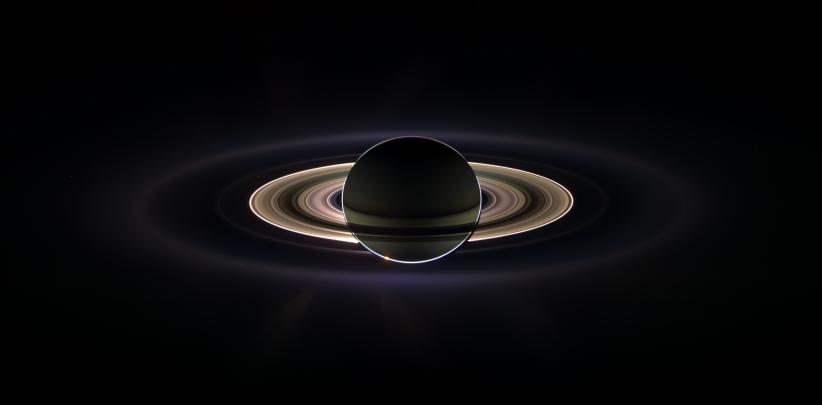
As always, see the Cassini home page for more.
Language Liberalism Freethought Birds
Verbing Weirds Language only if you're expecting it to work in a simple way. This is a special case of the more general truth that Language Weirds.
Only when a republic's life is in danger should a man uphold his government when it is in the wrong. There is no other time.
The church says Earth is flat; but I have seen its shadow on the moon, and I have more confidence in a shadow than the church.
If we can't find Heaven, there are always bluejays.
Cassini has been at Saturn for ten years now. Ten years! From among my favorites:
Cassini has been at Saturn for ten years now. Ten years! From among my favorites:

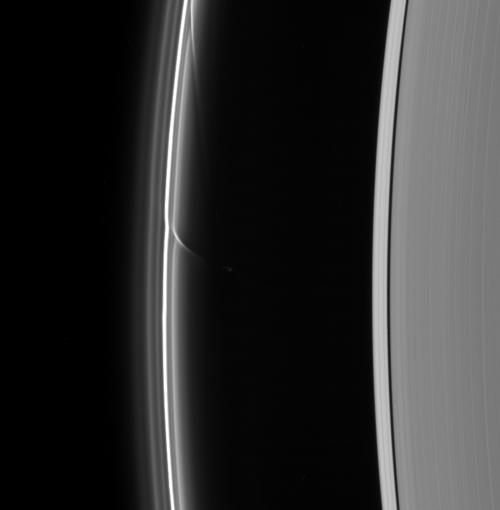 We keep seeing wondrous things through Cassini's eyes. Prometheus (102 kilometers, or 63 miles across) is seen here with two long streamers of material that it has pulled out of the F ring. When Prometheus comes close to the F ring in its orbit, the moon's gravity tugs on the ring particles. The disturbed particles, now pulled into orbits slightly closer to Saturn and therefore faster, shear out during successive orbits, creating the long and delicate streamers seen here.
Subscribe to Post Comments [Atom]
Cassini has been at Saturn for ten years now. Ten years! From among my favorites:


 What moon is that? How can a moon of Saturn be so centered on the A Ring?
Subscribe to Post Comments [Atom]
Cassini has been at Saturn for ten years now. Ten years! From among my favorites:


 Oh. Wow.
Subscribe to Post Comments [Atom]
Cassini has been at Saturn for ten years now. Ten years! From among my favorites:
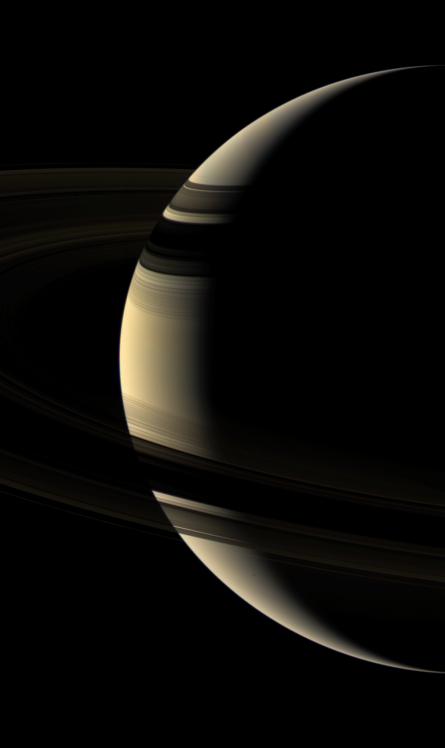

 From 24 degrees above the unlit rings, Cassini gazes down at the A Ring, with tiny Pan in the Encke Gap and the F Ring at the far outside (the bottom of the shot). Saturn is visible through the ring.
Subscribe to Post Comments [Atom]
Seriously, people? 1998? Last American to stay there? The International Space Station? There are three Americans there right now.
 had this to say...
It all depends on your point of view ;-)
Subscribe to Post Comments [Atom]

 And let's not forget to teach the controversy! Ha Birthday SMS had this to say...
Salute to Great Visionary who changed the thinking of people about the universe
Subscribe to Post Comments [Atom]
 Today in 1571 Johannes Kepler was born in Wurttemberg, Germany. Kepler was born to Lutheran parents, but never subscribed fully to the doctrine of "the real presence" and refused to sign the Formula of Concord; therefor he was excluded from the sacrament. Being unaccepted by the Lutherans and not a Catholic, either, Kepler had no refuge during the Thirty Years War and the counter-reformation, which meant he was forced to move over and over again to stay alive.
Kepler was forced to leave his teaching post at Graz due to the counter Reformation because he was Lutheran and moved to Prague to work with the renowned Danish astronomer, Tycho Brahe. He inherited Tycho's post as Imperial Mathematician when Tycho died in 1601. Using the precise data that Tycho had collected, Kepler discovered that the orbit of Mars was an ellipse. In 1609 he published Astronomia Nova, delineating his discoveries, which are now called Kepler's first two laws of planetary motion. And what is just as important about this work, "it is the first published account wherein a scientist documents how he has coped with the multitude of imperfect data to forge a theory of surpassing accuracy" (O. Gingerich in forward to Johannes Kepler New Astronomy translated by W. Donahue, Cambridge Univ Press, 1992), a fundamental law of nature. Today we call this the scientific method.
In 1612 Lutherans were forced out of Prague, so Kepler moved on to Linz. His wife and two sons had recently died. He remarried happily, but had many personal and financial troubles. Two infant daughters died and Kepler had to return to Württemburg where he successfully defended his mother against charges of witchcraft. In 1619 he published Harmonices Mundi, in which he describes his "third law."
In spite of more forced relocations, Kepler published the seven-volume Epitome Astronomiae in 1621. This was his most influential work and discussed all of heliocentric astronomy in a systematic way. He then went on to complete the Rudolphine Tables that Tycho had started long ago. These included calculations using logarithms, which he developed, and provided perpetual tables for calculating planetary positions for any past or future date. Kepler used the tables to predict a pair of transits by Mercury and Venus of the Sun, although he did not live to witness the events.
Johannes Kepler died in Regensburg in 1630, while on a journey from his home in Sagan to collect a debt. His grave was demolished within two years because of the Thirty Years War. Frail of body, but robust in mind and spirit, Kepler was scrupulously honest to the data.
Labels: astronomy, birthdays, freethought, science
Subscribe to Post Comments [Atom]
The ISS is still up there, and even has two Americans on board, along with a Canadian and three Russians.
Subscribe to Post Comments [Atom]
Frederick William Herschel, born Friedrich Wilhelm Herschel, was born today in 1738. Herschel is most famous for the discovery of Uranus in addition to two of its major moons, Titania and Oberon. He also discovered two moons of Saturn - Enceladus and Mimas, shown below (they're tiny! yet large enough to be rounded by self-gravity), Enceladus against the clouds and Mimas below the rings. Mimas, by the way, is the "Death Star moon", its huge Herschel crater prominent in the photo at the bottom.


Subscribe to Post Comments [Atom]
 (imgage source)
Subscribe to Post Comments [Atom]
A number of people were born today, including Emmanuel Ax, in 1949 - I love his playing; Francis Crick, in 1916, who helped discover DNA; John W Campbell, in 1910, arguably the greatest influence on science fiction ever; and Giovanni Domenico Cassini, in 1625, who discovered the Cassini Gap in the rings of Saturn, the broad black band in the 2004 Hubble telescope's picture below...

Labels: astronomy, birthdays, entertainment, photos
Subscribe to Post Comments [Atom]
William Wallace Campbell was born today on a farm in Ohio, in 1862. He was a a pioneer of astronomical spectroscopy and catalogued the radial velocities of stars, was director of the Lick Observatory for 30 years, and led expeditions to photograph stars and solar eclipses in the Southern Hemisphere, one of which provided further evidence supporting Albert Einstein's theory of relativity. His obituary in the Monthly Notices of the Royal Astronomical Society, Vol. 99, p.317, says, in small part:
Campbell was not one of those blown about by every idle wind of astronomical doctrine; no-one ever called him a weather-vane. And the implication that he was not especially receptive to new tenors of thought is true. His method was to push ahead in his own established line of research rather than to experiment with trial balloons in the hope of reaching other levels. He has been criticized on this score, but, if criticism be limited to those who have accomplished as much as he, not many are entitled to be heard.
Subscribe to Post Comments [Atom]
I remember years ago when Apollo 13 had just come out on video, I was in Saturday Matinee and they were playing it on the store's TV monitors. They had gotten to the point in the movie where the Saturn is lifting off the launching pad. I was just standing there watching, and a man about my age was standing next to me, mesmerized.
Labels: astronomy, links, miscellaneous, science
Subscribe to Post Comments [Atom]
 Today in 1855, Percival Lowell was born. He didn't discover Pluto, but his belief that Planet X lay beyond Neptune and Uranus and perturbed their orbits led to its discovery. Pluto of course isn't big enough to be "Planet X" - in fact, the whole "Planet X" thing was due to a mistake in measuring the mass of Neptune.
 popularization efforts; and his obsessive drawings of canals and oases on Mars, the remnants of a desperate and dying ancient civilization ... well, you do have to admit that maybe Lowell had more money than sense.
Labels: astronomy, birthdays, entertainment, science
Subscribe to Post Comments [Atom]
Frederick William Herschel, born Friedrich Wilhelm Herschel, was born today in 1738. Herschel is most famous for the discovery of Uranus in addition to two of its major moons, Titania and Oberon. He also discovered two moons of Saturn - Enceladus and Mimas, shown below (they're tiny! yet large enough to be rounded by self-gravity), Enceladus against the clouds and Mimas below the rings. Mimas, by the way, is the "Death Star moon", its huge Herschel crater prominent in the photo at the bottom.
Subscribe to Post Comments [Atom]
Wow. Just ... wow.

Subscribe to Post Comments [Atom]
It's been quite a while, hasn't it? But here's another gorgeous photo from Cassini: four moons and the edge of the rings. Ids are below the photo - see if you can spot all four. (Select the photo for a bigger version; you might need it!)
Subscribe to Post Comments [Atom]
Subscribe to Post Comments [Atom]
A number of people were born today, including Emmanuel Ax, in 1949 - I love his playing; Francis Crick, in 1916, who helped discover DNA; John W Campbell, in 1910, arguably the greatest influence on science fiction ever; and Giovanni Domenico Cassini, in 1625, who discovered the Cassini Gap in the rings of Saturn, the broad black band in the 2004 Hubble telescope's picture below...
had this to say...
Have you ever seen the rings of Saturn through a telescope. A friend set one up a few years ago when Saturn was in a very good viewing position and orientation. It looks like a Christmas ornament. It's hard to believe that it's actually there.
 The Ridger, FCD had this to say...
I have, once. It certainly looks ... unreal.
Subscribe to Post Comments [Atom]

I used to teach Russian and Ukrainian, and some basic English, to civil servants. Now I teach Russian at a local continued-learning institute. I dabble in Gaelic and Welsh. I'm am amateur photographer and I love birding (in a small way). I'm a Progressive, and a Freethinker, and I know Evolution is a fact - that's FCD, Friend of Charles Darwin (look down the sidebar). I read a lot, and follow women's college basketball. Also I love astronomy, though I'm a rank amateur at it. Most of all, I like living in the reality-based community...
 | Helping Our Homeless Youth |
 | After Firedog Lake, there's Shadowproof. |
 | |
| Free Raif - Take Action |


Subscribe to
Posts [Atom]









Cost of the War in Iraq
(JavaScript Error)




















We seem to have ended up with secularism because there was no other fair way of managing equal citizenship in a plural society; no other reasonable way to share a globe overrun with jealous gods. But what a thing to have achieved! A public ethos that embraces all of us in its insistence on fairness and mutual respect here and now on the beautiful, benighted Earth we share, not in the afterlife that we don't.
—-Thomas MacCamish
The past is not a shadow theatre. What rules there is not the ephemeral, but the irreversible.
—Gen-Col Dmitri Antonovich Volkogonov
Unless someone like you cares a whole awful lot, nothing is going to get better. It's not.
—Dr. Seuss
The people of the U.S. owe their independence & liberty to the wisdom of descrying in the minute tax of 3 pence on tea, the magnitude of the evil comprised in the precedent. Let them exert the same wisdom in watching against every evil lurking under plausible disguises, and growing up from small beginnings.
—James Madison
If once a man indulges himself in murder, very soon he comes to think little of robbing; and from robbing he comes next to drinking and Sabbath-breaking, and from that to incivility and procrastination. Once begun upon this downward path, you never know where you are to stop. Many a man has dated his ruin from some murder or other that perhaps he thought little of at the time.”
—Thomas De Quincey
If one embraces an atheist worldview, it necessarily requires embracing, even celebrating, one's insignificance. It's a tall order, I know, when one is accustomed to being the center of attention. The universe existed in all its vastness before I was born, and it will exist and continue to evolve after I am gone. But knowing that doesn't make me feel bleak or hopeless: I find it strangely comforting. Nor does it make me feel like nothing I do could possibly matter -- quite the opposite: everything we do matters a great deal. That's the great paradox. It makes our short time here on Earth incredibly precious, in which every moment should be savored. I tell my husband I love him every single day, because those days are finite. Fifty years will be gone in an instant from a cosmological perspective. Our choices, our actions, how we choose to behave toward our fellow travelers -- random kindness to strangers -- all of this becomes tremendously important when one embraces insignificance... because this life is all we have.
—Jennifer Ouellette
The subjects of every state ought to contribute towards the support of the government, as nearly as possible, in proportion to their respective abilities; that is, in proportion to the revenue which they respectively enjoy under the protection of the state.
—Adam Smith, The Wealth of Nations
It is not self-evident that there is no problem with believing implausible things for epistemically questionable reasons.
—Ophelia Benson
Whenever I hear the president mention, oh, every 12 minutes, that his greatest responsibility is "to protect the American people," the insufferable civics robot inside my head mutters: "Actually, sir, your oath, the one with the Bible and the chief justice and the Jumbotron, is to protect and defend the Constitution of the United States. For the American people are not mere flesh whose greatest hope is to keep our personal greasy molecules intact; we, sir, are a body politic -- with ideals."
—Sarah Vowell
Democracy is great because it is safe to be in the minority.
—Adlai Stevenson
Any who act as if freedom's defenses are to be found in suppression and suspicion and fear confess a doctrine that is alien to America.
—Dwight D. Eisenhower
If we can't find Heaven, there are always bluejays.
—Robert Bly
Verbing Weirds Language only if you're expecting it to work in a simple way. This is a special case of the more general truth that Language Weirds.
—John Lawler
Only when a republic's life is in danger should a man uphold his government when it is in the wrong. There is no other time.
—Mark Twain
Languages certainly do follow rules, but they don’t follow orders.
—Peter Sokolowski
The church says the earth is flat; but I have seen its shadow on the moon, and I have more confidence in the shadow than in the church.
—Robert Ingersoll (attr. to Magellan)
There is no harm in a man’s limiting his employment of none to the singular in his own individual usage, if he derives any pleasure from this particular form of linguistic martyrdom. But why should he go about seeking to inflict upon others the misery which owes its origin to his own ignorance?
—Thomas R. Lounsbury
I am tolerant of all creeds. Yet if any sect suffered itself to be used for political objects I would meet it by political opposition. In my view church and state should be separate, not only in form, but fact. Religion and politics should not be mingled.
—Millard Fillmore
You carve through what is known and you come to this precipice between what is known and the unknown, and that's where the research scientist lives. And that is what excites a person to rush to work every day.
—Neil DeGrasse Tyson
The United States has adventured upon a great and noble experiment, which is believed to have been hazarded in the absence of all previous precedent — that of total separation of Church and State. No religious establishment by law exists among us. The conscience is left free from all restraint and each is permitted to worship his Maker after his own judgment. The offices of the Government are open alike to all. No tithes are levied to support an established Hierarchy, nor is the fallible judgment of man set up as the sure and infallible creed of faith. The Mohammedan, if he will to come among us would have the privilege guaranteed to him by the Constitution to worship according to the Koran; and the East Indian might erect a shrine to Brahma if it so pleased him. Such is the spirit of toleration inculcated by our political institutions… The Hebrew persecuted and down trodden in other regions takes up his abode among us with none to make him afraid… and the Aegis of the government is over him to defend and protect him. Such is the great experiment which we have tried, and such are the happy fruits which have resulted from it; our system of free government would be imperfect without it.
—John Tyler
What you need most was always Destroyed in the Great Fire.
—Metelleus (Murphy's Laws for Linguists)
I have encountered a few creationists and because they were usually nice, intelligent people, I have been unable to decide whether they were really mad, or only pretending to be mad. If I was a religious person, I would consider creationism nothing less than blasphemy. Do its adherents imagine that God is a cosmic hoaxer who has created that whole vast fossil record for the sole purpose of misleading mankind?
—Arthur C. Clarke
For my part I know nothing with any certainty, but the sight of the stars makes me dream.
—Vincent van Gogh
I'm not convinced that faith can move mountains, but I've seen what it can do to skyscrapers.
—William H. Gascoyne
What happened was the gradual habituation of the people, little by little, to be governed by surprise, to receiving decisions deliberated in secret; to believe that the situation was so complicated that the governmnt had to act on information which the people could not understand, or so dangerous that, even if people could understand it, it could not be released because of national security.
—Milton Stanford Mayer (They Thought They Were Free: The Germans 1933-35)
Also, I have to say that I hate this role of correcting elementary errors of linguistic analysis, or questioning unthinking prescriptions that are logically incoherent, factually wrong and promptly disobeyed by the prescriber. Historians aren't constantly confronted with people who carry on self-confidently about the rule against adultery in the sixth amendment to the Declamation of Independence, as written by Benjamin Hamilton. Computer scientists aren't always having to correct people who make bold assertions about the value of Objectivist Programming, as examplified in the HCNL entities stored in Relaxational Databases. The trouble is, most people are much more ignorant about language than they are about history or computer science, but they reckon that because they can talk and read and write, their opinions about talking and reading and writing are as well informed as anybody's. And since I have DNA, I'm entitled to carry on at length about genetics without bothering to learn anything about it. Not.
—Mark Liberman
...when people thought the earth was flat, they were wrong. When people thought the earth was spherical, they were wrong. But if you think that thinking the earth is spherical is just as wrong as thinking the earth is flat, then your view is wronger than both of them put together.
—Isaac Asimov
Illnesses, like natural disasters, are not God's wrath, but ordinary phenomena that affect different populations at any given time. History, however, teaches us that the most enduring disease is divisiveness in the name of the Divine, that predictably rears its ugly head at the very moments when healing is needed instead of hatred.
—Wayne Besen
Funny how languages break down and turn into something else. Latin was rubbed away until it degenerated into dreadful lingos like French and Italian and Spanish, and lo! people found out that quite new things could be said in those degenerate languages — things nobody had ever thought of in Latin. English is breaking down now in the same way — becoming a world language that every Tom Dick and Harry must learn, and speak in a way that would give Doctor Johnson the jim-jams.
—Robertson Davies (The Rebel Angels)
Truth irritates only those whom it enlightens but does not convert.
—Pasquier Quesnel
I think we ought to have as great a regard for religion as we can, so as to keep it out of as many things as possible.
—Sean O'Casey
If they are good workmen, they may be of Asia, Africa, or Europe. They may be Mohometans, Jews or Christians of any Sect, or they may be Atheists.
—George Washington
Positively the principle may be expressed: In matters of your intellect, follow your reason as far as it will take you, without regard to any other consideration. And negatively: In matters of the intellect, do not pretend that conclusions are certain which are not demonstrated or demonstrable. That I take to be the agnostic faith, which if a man keep whole and undefiled, he shall not be ashamed to look the universe in the face, whatever the future may have in store for him.
—Thomas Huxley
The United States of America have exhibited, perhaps, the first example of governments erected on the simple principles of nature; and if men are now sufficiently enlightened to disabuse themselves of artifice, imposture, hypocrisy, and superstition, they will consider this event as an era in their history. Although the detail of the formation of the American governments is at present little known or regarded either in Europe or in America, it may hereafter become an object of curiosity. It will never be pretended that any persons employed in that service had interviews with the gods, or were in any degree under the influence of Heaven, more than those at work upon ships or houses, or laboring in merchandise or agriculture; it will forever be acknowledged that these governments were contrived merely by the use of reason and the senses.
—John Adams (A Defence of the Constitutions of Government of the United States of America)
To bereave a man of life, or by violence to confiscate his estate, without accusation or trial, would be so gross and notorious an act of despotism as must at once convey the alarm of tyranny throughout the whole nation; but confinement of the person, by secretly hurrying him to jail, where his sufferings are unknown or forgotten, is a less public, a less striking, and therefore a more dangerous engine of arbitrary government.
—Alexander Hamilton quoting William Blackstone
It doesn't seem to me that this fantastically marvelous universe, this tremendous range of time and space and different kinds of animals, and all the different planets, and all these atoms with all their motions, and so on, all this complicated thing can merely be a stage so that God can watch human beings struggle for good and evil - which is the view that religion has. The stage is too big for the drama.
—Richard Feynman
Our government is the potent, the omnipresent teacher. Crime is contagious. If the government becomes a lawbreaker, it breeds contempt for the law; it invites every man to become a law unto himself.
—Justice Louis D. Brandeis, 1929
If there is one thing for which we stand in this country, it is for complete religious freedom, and it is an emphatic negation of this right to cross-examine a man on his religion before being willing to support him for office.
—Theodore Roosevelt
During almost fifteen centuries has the legal establishment of Christianity been on trial. What have been its fruits? More or less in all places, pride and indolence in the Clergy, ignorance and servility in the laity, in both, superstition, bigotry and persecution...What influence in fact have ecclesiastical establishments had on Civil Society? In some instances they have been seen to erect a spiritual tyranny on the ruins of the Civil authority; in many instances they have been seen upholding the thrones of political tyranny: in no instance have they been seen the guardians of the liberties of the people. Rulers who wished to subvert the public liberty, may have found an established Clergy convenient auxiliaries. A just Government instituted to secure & perpetuate it needs them not.
—James Madison
I do not feel obliged to believe that the same God who has endowed us with senses, reason, and intellect has intended us to forgo their use.
—Galileo Galilei
When it was playing-for-keeps time, when life was drawing a line in the sand, he suddenly knew which side he stood. It was cold, dark and scary that side of the line, and there was nobody there to help you, but once you're there you can't return. Once you've seen behind the backdrop, you can't walk out front again and believe that what's painted on it is real. The world this side of the line is indeed a more foreboding place, but even though you have to tread with more caution, you walk with more dignity.
—Christopher Brookmyre, Not the End of the World
If there's no great glorious end to all this, if nothing we do matters - then all that matters is what we do, now, today. All I want to do is help - because people shouldn't suffer as they do. If there isn't any bigger meaning, then the smallest act of kindness is the greatest thing in the world.
—Angel
[T]he term "Darwinist" is a term that suggests a "belief" in Darwin's ideas. The proper term for someone who accepts and works productively with evolutionary theory is "scientist."
—Liz Craig
Loyalty to petrified opinion never broke a chain or freed a human soul.
—Mark Twain
The Christian priesthood, finding the doctrines of Christ levelled to every understanding and too plain to need explanation, saw, in the mysticisms of Plato, materials with which they might build up an artificial system which might, from its indistinctness, admit everlasting controversy, give employment for their order, and introduce it to profit, power and preeminence. The doctrines which flowed from the lips of Jesus himself are within the comprehension of a child; but thousands of volumes have not yet explained the Platonisms engrafted on them: and for this obvious reason that nonsense can never be explained.
—Thomas Jefferson
It is the habit of mankind to entrust to careless hope what they long for, and to use sovereign reason to thrust aside what they do not desire.
—Thucydides
[I]t's not in the Bible, unless you read between the lines. (Bibles, by the way, are something like quintuple-spaced.)
—Mike Speir
Religion is an insult to human dignity. With or without it, you'd have good people doing good things and evil people doing evil things. But for good people to do evil things, it takes religion.
—Steven Weinberg
There is in every village a torch - the teacher - and an extinguisher - the clergyman.
—Victor Hugo
Constitutions are chains with which men bind themselves in their sane moments that they may not die by a suicidal hand in the day of their frenzy.
—Sen. John Stockton
But a Constitution of Government once changed from Freedom, can never be restored. Liberty, once lost, is lost forever.
—John Adams
No one likes armed missionaries.
—Robespierre
It does me no injury for my neighbor to say there are twenty gods or no God. It neither picks my pocket nor breaks my leg.
—Thomas Jefferson
Injustice anywhere is a threat to justice everywhere. We are caught in an inescapable network of mutuality, tied in a single garment of destiny. Whatever affects one directly, affects all indirectly.
—Martin Luther King, Jr
The money power preys upon the nation. It is more despotic than monarchy, more insolent than aristocracy, more selfish than bureaucracy. It denounces, as public enemies, all who question its methods or throw light upon its abuses.
—Abraham Lincoln
Those who can make you believe absurdities, can make you commit atrocities.
—Voltaire
Science presents us with a meal so rich we can hardly choose among the courses, and the theist wishes us to starve.
—Blake Stacey
Human beings are perhaps never more frightening than when they are convinced beyond doubt that they are right.
—Laurens Van der Post
So this universe is amazingly well designed to allow life to occur, which, of course, means that it is impossible for life to occur in this universe without a miracle happening.
—Steven Carr
Facts are stubborn things; and whatever may be our wishes, our inclinations, or the dictates of our passion, they cannot alter the state of facts and evidence.
—John Adams
When fascism comes to America it will be wrapped in a flag and carrying a cross.
—Sinclair Lewis
Fairy tales do not tell children the dragons exist. Children already know that dragons exist. Fairy tales tell children the dragons can be killed.
—GK Chesterton
Trouble is, there's a fine line between imagining someone's eternal soul is condemned and thinking their earthly life is worthless.
—Christopher Brookmyre, Not the End of the World
Question with boldness even the existence of god; because if there be one, he must more approve the homage of reason than that of blindfolded fear.
—Thomas Jefferson
Like one of the devouring gods of old, The Market --aptly embodied in a bull or bear-- must be fed and kept happy under all circumstances. That The Market is not at all displeased by downsizing or a growing income gap, or can be gleeful about the expansion of cigarette sales to Asian young people, should not cause anyone to question its ultimate omniscience. Like Calvin's inscrutable deity, The Market may work in mysterious ways, 'hid from our eyes', but ultimately it knows best.
—Harvey Cox
Liberalism is trust of the people, tempered by prudence; conservatism, distrust of people, tempered by fear.
—William Gladstone
He that would make his own liberty secure, must guard even his enemy from oppression; for if he violates this duty, he establishes a precedent that will reach to himself.
—Thomas Paine
The means of defense against foreign danger historically have become the instruments of tyranny at home.
—James Madison
To give aid to every poor man is far beyond the reach and power of every man -- care of the poor is encumbent upon society as a whole.
—Baruch Spinoza
There is danger from all men. The only maxim of a free government ought to be to trust no man living with power to endanger the public liberty.
—John Adams
In the end, our society will be defined not only by what we create but by what we refuse to destroy.
—John Sawhill
There is no method of reasoning more common, and yet none more blameable, than, in philosophical disputes, to endeavor the refutation of any hypothesis, by a pretence of its dangerous consequences to religion and morality. When any opinion leads to absurdities, it is certainly false; but it is not certain that an opinion is false, because it is of dangerous consequence.
—David Hume
In this great and creatorless universe, where so much beautiful has come to be out of the chance interactions of the basic properties of matter, it seems so important that we love one another.
—Lucy Kemnitzer
We cannot defend freedom abroad by abandoning it at home.
—Edward R. Murrow
It is now no more that toleration is spoken of, as if it was by the indulgence of one class of people that another enjoyed the exercise of their inherent natural rights. For happily the Government of the United States, which gives to bigotry no sanction, to persecution no assistance, requires only that they who live under its protection, should demean themselves as good citizens.
—George Washington
It is difficult to get a man to understand something, when his salary depends on his not understanding it.
—Upton Sinclair
I am an atheist, out and out. It took me a long time to say it. I've been an atheist for years and years, but somehow I felt it was intellectually unrespectable to say one was an atheist, because it assumed knowledge that one didn't have. Somehow it was better to say one was a humanist or an agnostic. I finally decided that I'm a creature of emotion as well as of reason. Emotionally I am an atheist. I don't have the evidence to prove that God doesn't exist, but I so strongly suspect he doesn't that I don't want to waste my time.
—Isaac Asimov
Be this as it may, in every free and deliberating society, there must, from the nature of man, be opposite parties, and violent dissensions and discords; and one of these, for the most part, must prevail over the other for a longer or shorter time. Perhaps this party division is necessary to induce each to watch and relate to the people the proceedings of the other. But if on a temporary superiority of the one party, the other is to resort to a scission of the Union, no federal government can ever exist. ... A little patience, and we shall see the reign of witches pass over, their spells dissolved, and the people recovering their true sight, restoring their government to its true principles. It is true, that in the meantime, we are suffering deeply in spirit, and incurring the horrors of a war, and long oppressions of enormous public debt. .... If the game runs sometimes against us at home, we must have patience till luck turns, and then we shall have an opportunity of winning back the principles we have lost. For this is a game where principles are the stake. Better luck, therefore, to us all, and health, happiness and friendly salutations to yourself. Adieu.
—Thos. Jefferson
If the world in which we live has been produced in accordance with a Plan, we shall have to reckon Nero a saint in comparison with the Author of that Plan.
—Bertrand Russell
I believe there are more instances of the abridgement of freedom of the people by gradual and silent encroachments by those in power than by violent and sudden usurpations.
—James Madison
A country that demands unanimity and calls it patriotism is a country that has lost its bearings.
—Carlos Fuentes
Those who would give up essential liberty to purchase a little temporary safety deserve neither liberty nor safety.
—Benjamin Franklin (attr.)
Alas, to wear the mantle of Galileo it is not enough that you be persecuted by an unkind establishment, you must also be right.
—Robert Park
Our country right or wrong. When right, to be kept right; when wrong, to be put right.
—Carl Schurz
I fear you do not fully comprehend the danger of abridging the liberties of the people. Nothing but the very sternest necessity can ever justify it. A government had better go to the very extreme of toleration, than to do aught that could be construed into an interference with, or to jeopardize in any degree, the common rights of its citizens.
—Abraham Lincoln
Fanatcism consists in redoubling your efforts when you have lost sight of your aims.
—George Santayana
It is almost superfluous to remark that a democratic Government always shows worst where other Governments generally show best -- on its outside; that unreasonable people are much more noisy than the reasonable; that the froth and scum are the part of a violently fermenting liquid that meets the eyes, but are not its body and substance.
—John Stuart Mill
If there is any fixed star in our constitutional constellation, it is that no official, high or petty, can prescribe what shall be orthodox in politics, nationalism, religion, or other matters of opinion.
—Justice Robert Jackson
This is a godless universe and it thrills me that I have the chance to ride along with it, even if only for my few decades of awareness. Many people turn to religion saying, "But there has to be more to it all than this." To them I say, "Look around you! What more could you ask for?" In terms of Truth, Beauty and Wonder, all the world's religions cannot compete with a clear, cold, moonless night. We are star-stuff, you and I. We are children of the supernova and our beginnings lie in the death of a star.
—Adrian Barnett
We must not confuse dissent with disloyalty. When the voice of loyal opposition dies, I think the soul of America dies with it.
—Edward R Murrow
Reality is that which, when you stop believing in it, doesn't go away.
—Philip K Dick
The despotism of custom is everywhere the standing hindrance to human advancement.
—John Stuart Mill
Of all the frictional resistance, the one that most retards human movement is ignorance, what Buddha called "the greatest evil in the world." The friction which results from ignorance can be reduced only by the spread of knowledge and the unification of the heterogeneous elements of humanity. No effort could be better spent.
—Nikola Tesla
[A]n amendment was proposed by inserting "Jesus Christ," so that [the preamble] should read "A departure from the plan of Jesus Christ, the holy author of our religion"; the insertion was rejected by a great majority, in proof that they meant to comprehend, within the mantle of its protection, the Jew and the Gentile, the Christian and Mohammedan, the Hindoo and Infidel of every denomination.
—Thos. Jefferson
The President is merely the most important among a large number of public servants. He should be supported or opposed exactly to the degree which is warranted by his good conduct or bad conduct, his efficiency or inefficiency in rendering loyal, able, and disinterested service to the Nation as a whole. Therefore it is absolutely necessary that there should be full liberty to tell the truth about his acts, and this means that it is exactly necessary to blame him when he does wrong as to praise him when he does right. Any other attitude in an American citizen is both base and servile. To announce that there must be no criticism of the President, or that we are to stand by the President, right or wrong, is not only unpatriotic and servile, but is morally treasonable to the American public. Nothing but the truth should be spoken about him or any one else. But it is even more important to tell the truth, pleasant or unpleasant, about him than about any one else.
—Theodore Roosevelt
In this world of sin and sorrow there is always something to be thankful for; as for me, I rejoice that I am not a Republican.
—H L Mencken
0 Comments:
-
<-- Older Post ^ HomePost a Comment
Subscribe to Post Comments [Atom]